Now that the DNA's have fused together, the egg has to start forming an embryo. You can't do much when you are one little cell - so you have to divide. This process is called cleavage. You divide in half, and in half, and in half again... Until you have so many cells that scientists give you a new name. Your new name is morula. A morula has 16 - 32 cells while still being in the zona pellucida.

Now you clump together so much that one side is full of embryoblasts and the other is empty. the clustered end is called the inner cell mass and the pocket is called the blastocoel. After all of that is a process called blastulation. Suddenly, your zona pellucida starts to disintegrate away...
Now that your zona pellucida has disintegrated, you form something called an amniotic cavity. This is on the side of epiblasts. On the other side of the you get hypoblasts. The epiblasts are sort of like a barrier to the amniotic cavity. The hypoblasts is called the bilameter disk. You then start to see a streak running along the bilaminar disk. This is called the primitive streak. Next we get another layer of cells. Now you have a trilaminar disk. There are three layers. The ectoderm (top), mesoderm (middle), and the endoderm (bottom).
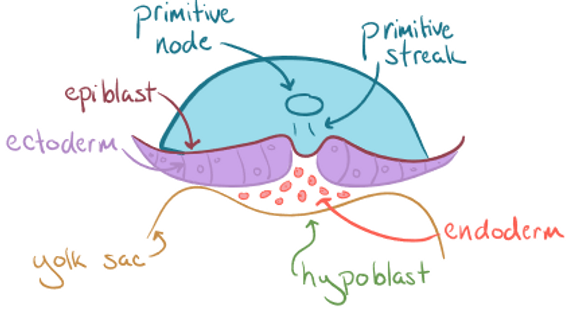
The mesoderm forms the notochord which is very important to the nurology of the embryo. In the ectoderm you form a neural plate, and the neural plate cells form a tube by going into the mesoderm. It is now called the neural tube, and early embryogenesis is complete! Next we will move onto the bone growth.